
The Role of A.I. in Music Post-Production
I have all the lyrics and melodies. What I don't have is a forty-piece orchestra, a band, engineers, and a recording studio waiting whenever inspiration strikes.
A.Greenhalgh
8/14/20266 min read
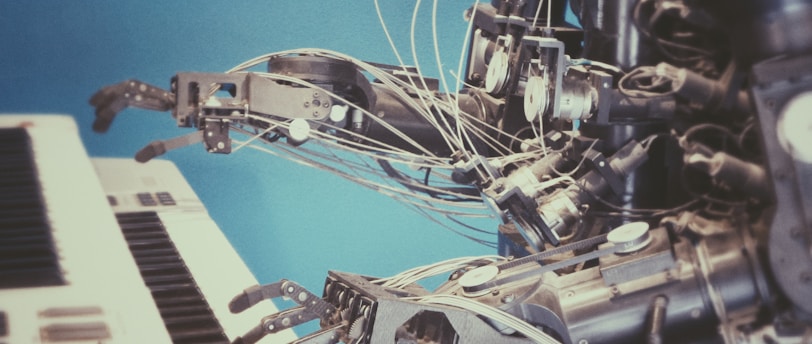

The Role of A.I. in Music Post-Production
I have a confession to make.
I am not a very good singer.
I cannot read music. I cannot write music in the conventional sense. I cannot sit down with a sheet of manuscript paper and tell you what the notes are called. And, despite having spent an unreasonable proportion of my life making music, I have never had the luxury of having a band, an orchestra, a recording studio and a room full of highly skilled session musicians sitting around waiting for the next idea to arrive.
And yet, as a child, I was rather good at writing songs.
Give me a piano and I could find melodies. Better still, I could invent them. I could hear something in my head and hunt around until I found the notes that approximated what I was hearing. I knew when a chord was wrong because it felt wrong. I knew when a melody worked because something happened inside me when I played it.
What I didn't possess was the infrastructure required to turn those ideas into finished recordings.
That distinction matters.
Because when people talk about Artificial Intelligence in music, there seems to be an extraordinary tendency to confuse the production of music with the conception of music.
They are not the same thing.
For someone like me, A.I. is not a replacement for creativity. It is a bridge between creativity and reality.
It is, in effect, a prosthetic.
If an amputee is given a prosthetic limb, we don't look at them walking and say, "That's cheating. Your artificial leg walked for you."
Of course we don't.
The prosthetic is an extension of human intention. The human decides where to go. The technology makes it possible to get there.
I see A.I. in music in much the same way.
I have ideas. I have melodies. I have lyrical concepts. I have arrangements in my head. I have a particular emotional response I want a piece of music to create. What I don't necessarily have is a forty-piece orchestra, a professional vocalist, a drummer, a bassist, a guitarist, a string arranger, a recording engineer, a mixing engineer and a mastering engineer available every time inspiration strikes.
Historically, that meant that many ideas simply died.
Not because they were bad ideas, but because I lacked the machinery to realise them.
That is an important distinction in the current A.I. debate.
The technology isn't necessarily replacing an artist.
Sometimes it is finally giving the artist the means to become an artist.
This isn't even particularly revolutionary.
Photography didn't kill painting. Synthesisers didn't kill musicians. Drum machines didn't destroy rhythm. Digital audio didn't make recording studios morally corrupt. Auto-Tune didn't abolish singing.
Technology has repeatedly changed the definition of what it means to make music.
The piano itself is technology.
So is the microphone.
So is the electric guitar.
So is the tape machine.
So is the sampler.
So is the DAW.
And now A.I. is becoming another instrument in that chain.
The difference is that this instrument can do things previous instruments could not.
It can interpret an instruction. It can suggest an arrangement. It can create a harmonic bed around a melody. It can generate orchestration. It can separate stems. It can help repair a performance. It can assist with mixing and mastering. Increasingly, it can allow someone to manipulate music at a level of abstraction much closer to the way they actually think about music.
Google's Music AI research, for example, explicitly describes A.I. as part of a creative toolkit intended to help musicians explore ideas and new forms of expression.
And that is precisely how I think we should be approaching it.
Not as a machine that makes art instead of us.
But as a machine that allows us to do more with the art that already exists inside us.
There is another analogy I find useful.
Imagine a CGI artist in the early days of cinema.
Should we insist that they personally paint every single frame?
Of course not.
We accept that they will use software, textures, lighting systems, physics engines, pre-programmed movements and increasingly sophisticated computational tools. The artist's job isn't diminished because they didn't individually paint every pixel.
Quite the opposite.
The technology expands the artist's vocabulary.
The same is happening in music.
And this is where I become slightly uncomfortable with the emerging tendency to treat A.I. proficiency itself as something suspicious.
If we accept that A.I. is a tool, then surely mastery of that tool should be considered a skill.
Nobody penalises a guitarist for becoming exceptionally good at guitar.
Nobody penalises a producer for knowing their DAW inside out.
Nobody says to a photographer, "You used autofocus, therefore your photograph isn't yours."
Nobody says to a film director, "You used CGI, therefore you didn't really make the film."
So why should we suddenly decide that someone who becomes exceptionally skilled at directing an A.I. system has somehow forfeited their artistic legitimacy?
There is a crucial difference between pressing a button and accepting whatever comes out and directing an extraordinarily sophisticated creative process towards a particular artistic objective.
The latter can require enormous judgement.
You have to know what you want.
You have to recognise what is wrong.
You have to reject hundreds of possibilities.
You have to refine prompts, arrangements, instrumentation, structure, performance, tone, dynamics and production.
You have to know when something is emotionally convincing and when it is merely technically impressive.
And, perhaps most importantly, you have to have a reason for making it.
That last part cannot be automated.
A.I. can generate ten thousand possibilities.
It cannot tell you which one means something to you.
That remains the artist's job.
There is, undoubtedly, a legitimate debate around copyright, consent, training data, vocal imitation, attribution and the economic impact of generative music. These aren't trivial questions and they shouldn't be dismissed simply because somebody happens to be excited about the technology.
Nor should we pretend that every piece of A.I.-generated music is automatically profound.
It isn't.
There is an enormous amount of disposable A.I. music being produced, just as there is an enormous amount of disposable human music.
In fact, perhaps the most interesting challenge of the next decade won't be whether machines can make music.
They clearly can.
It will be whether humans can still make interesting choices.
The danger isn't A.I.
The danger is mediocrity multiplied by infinite scalability.
That is a very different problem.
And it is why I don't think the answer is to discourage artists from mastering these tools. We should do precisely the opposite.
Teach people how they work.
Teach people how to direct them.
Teach people about copyright and consent.
Teach people about composition, arrangement, production and critical listening.
Teach them to recognise the difference between an idea and an output.
Because the future shouldn't belong exclusively to people who can afford the traditional machinery of music production.


Image: CGI did not replace the design process - it gave designers a better vehicle to convey ideas.
For centuries, artistic opportunity has been constrained by access.
You needed instruments.
You needed teachers.
You needed musicians.
You needed studios.
You needed money.
You needed contacts.
You needed time.
A.I. is beginning to knock holes in those walls.
And for somebody like me, that is not a threat to creativity.
It is an extraordinary liberation.
The little boy who could sit at a piano and invent a melody but couldn't assemble the orchestra to perform it now has access to something approaching an orchestra.
Not because the orchestra has become irrelevant, but because the idea no longer has to die simply because the orchestra isn't in the room.
That is what I mean when I talk about empowering artistic vision.
The question shouldn't be, "Did a human make every sound?"
The more interesting question is: "Did a human have something worth saying?"
If they did, and technology allowed them to say it more effectively, why on earth would we want to stop them?
A.I. should not replace artistic vision.
It should make artistic vision harder to imprison.
And perhaps that is the real revolution.
For the first time, an enormous number of people may be able to move directly from "I can hear it in my head" to "Here it is."
I don't see that as the death of music. I see it as the democratisation of possibility.
And if someone is good enough to master the machine, control it rather than be controlled by it, and use it to express something that could not otherwise exist, I don't think we should penalise them for doing so.
I think we should ask them what they've got to say.
Then listen.